Heatsink Types Explained: Passive vs Active Cooling, Materials & Selection Guide

Heat sinks pulls heat away from electronics so they run cooler, last longer, and avoid thermal shutdown. Despite the huge range of shapes on the market, almost every design falls into two families-passive and active-and is further defined by its material, fin geometry, and manufacturing process.
This guide walks through how each type works, compares aluminum and copper, explains when heat pipes and vapor chambers earn their place, and gives you a practical way to size and select a heatsink using a single thermal-resistance calculation. If you only remember one thing: match the heatsink to your actual power load, airflow, noise limit, and enclosure-not to a spec sheet measured in open air.
The Two Main Types: Passive vs Active Cooling
Passive heatsinks move heat using only conduction, natural convection, and radiation-no fans, no pumps, no moving parts. Active heatsinks add a powered mechanism, usually a fan, and often combine it with heat pipes or a vapor chamber to shift heat far faster. The right family depends on heat output, space, noise tolerance, and cost.

| Feature | Passive heatsink | Active heatsink |
|---|---|---|
| Cooling method | Natural convection and radiation | Forced airflow, often with heat pipes |
| Noise | Silent | Low to high, depending on fan speed |
| Cooling capacity | Moderate | High |
| Maintenance | Very low | Fan cleaning and eventual replacement |
| Cost | Usually lower | Usually higher |
| Typical use | LED lighting, routers, embedded systems | CPUs, GPUs, servers, industrial drives |
As a rough guide, loads below roughly 15–20 W are comfortable for passive cooling, 20–50 W sits in a gray zone that depends on airflow and enclosure, and above 50–100 W you usually need a fan, heat pipes, or a hybrid design.
How Passive Heatsinks Work

Heat leaves a component through a thermal interface material into the heatsink base, spreads through the metal, and finally transfers to the surrounding air. Because passive designs rely on warm air rising and cooler air replacing it, their performance is highly sensitive to orientation and to how open the enclosure is. A heatsink mounted vertically can convect noticeably better than the same part mounted flat, and the difference between an open bench and a sealed cabinet can easily double the effective thermal resistance.
Common passive designs
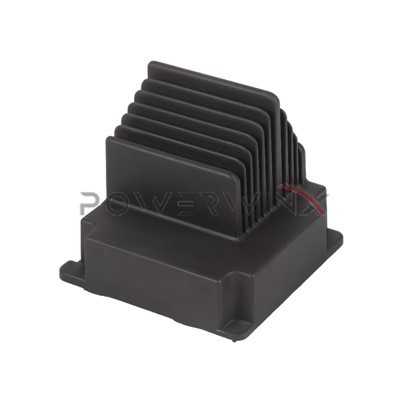
- Fin heatsinks use thin aluminum or copper fins to add surface area. They are the default for LED modules, network gear, and industrial enclosures.
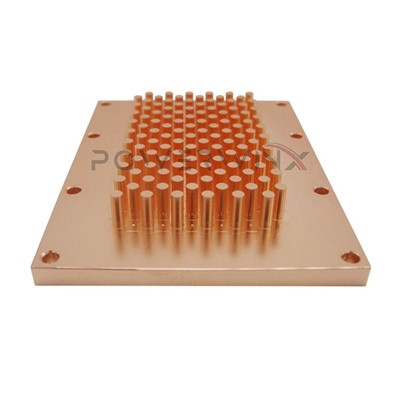
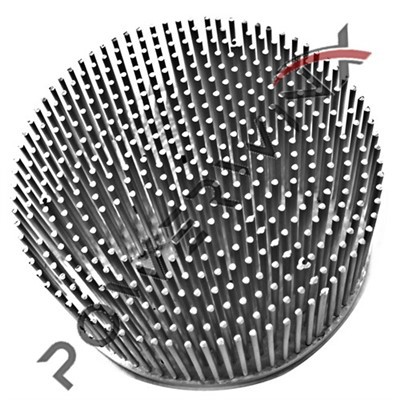
- Pin-fin heatsinks use arrays of vertical pins and cope well when airflow direction is unpredictable, since air can pass through from many angles.
- Stacked or solid block heatsinks trade size for robustness and are chosen where reliability matters more than compactness.
Fin spacing is the detail people most often get wrong. Pack the fins too tightly and warm air stagnates between them, choking natural convection; open them up and you gain airflow but lose total surface area. Passive designs live and die on this balance.
Aluminum vs copper
| Material | Thermal conductivity | Strengths | Trade-offs |
|---|---|---|---|
| Aluminum (e.g. 6063) | ~200–210 W/m·K | Light, cheap, easy to extrude, corrosion-resistant | Lower conductivity than copper |
| Copper | ~390–400 W/m·K | Excellent heat spreading, lower thermal resistance | ~3× heavier, costlier, harder to machine |
Aluminum dominates commercial products because it offers the best balance of performance, weight, and cost-extruded aluminum is especially economical for LED, telecom, and industrial gear. Copper is reserved for concentrated, high-density heat sources where its spreading advantage justifies the weight and price. Many high-performance parts split the difference with a copper base and aluminum fins.
Active Heatsinks: Fans, Heat Pipes, and Vapor Chambers
The simplest active heatsink is a finned block with a fan. Forced airflow replaces slow natural convection and can cut thermal resistance dramatically.Fan choice comes down to more than airflow volume:
Axial fans move air along the shaft axis and suit open layouts-desktops, power supplies, industrial cabinets. Common sizes are 80 mm and 120 mm.
Centrifugal (blower) fans generate higher static pressure, so they push air through dense fins or restricted channels better-servers and tightly packed enclosures.

The simplest active heatsink is a finned block with a fan. Forced airflow replaces slow natural convection and can cut thermal resistance dramatically.
Fan choice comes down to more than airflow volume:
- Axial fans move air along the shaft axis and suit open layouts-desktops, power supplies, industrial cabinets. Common sizes are 80 mm and 120 mm.
- Centrifugal (blower) fans generate higher static pressure, so they push air through dense fins or restricted channels better-servers and tightly packed enclosures.
Two numbers matter when specifying a fan: CFM (how much air it moves) and static pressure (how well it forces that air through resistance). Dense fin stacks need high static pressure; open fins need less. Higher RPM cools better but is louder, which is why most systems use PWM control to trade temperature against noise. In a living room or office the goal is rarely maximum airflow-it's the best cooling-to-noise ratio.
When heat pipes and vapor chambers help

A heat pipe moves heat by phase change: a working fluid evaporates near the hot end, travels to the cooler end, condenses, and wicks back. That gives it an effective conductivity of several thousand W/m·K-far beyond solid copper-so it can carry heat from a cramped hotspot to a larger, better-ventilated fin stack. A vapor chamber does the same but spreads heat in two dimensions, which is ideal for large dies like GPUs and high-power CPUs.
Heat pipes don't replace fins; they feed them. The rule of thumb:
- Concentrated heat in a small area, or heat that must be relocated away from the source → heat pipes usually win.
- Plenty of surface area and low heat density → a large plain fin heatsink is often more economical.
- Compact, high-power electronics → heat pipes or vapor chambers are typically required.
Their weak points are usually not the pipe itself but the solder or braze joints, so quality suppliers rely on leak testing and joint inspection. Well-made industrial heat pipes are commonly rated for tens of thousands of hours.
Manufacturing and Fin Geometry
How a heatsink is made sets its cost, minimum fin thickness, and achievable surface density.
| Process | Typical fin thickness | Best for |
|---|---|---|
| Extrusion | 0.8–2.5 mm | High-volume aluminum products |
| Skiving | 0.2–0.5 mm | Dense fins in a compact footprint |
| Bonded fin | Flexible | Large industrial assemblies |
| Die casting | Complex shapes | Automotive, integrated housings |
| CNC machining | Precision | Prototypes and low volume |
On geometry, straight (plate) fins give low pressure drop and shine when airflow direction is predictable, which makes them the natural choice for forced-air systems. Pin fins tolerate turbulent, multi-directional airflow but create more resistance, so they can underperform in weak airflow. Beyond the fin style, four parameters drive results: fin spacing, thickness, height, and edge shape-narrow spacing adds area but restricts air, taller fins add area but raise resistance, and rounded edges trim turbulence losses.
Sizing a Heatsink: The One Calculation You Need
Every selection starts from thermal resistance, measured in °C per watt. Lower is better.
Rth = ΔT ÷ Power
where ΔT is the maximum allowed temperature rise above ambient, and Power is the heat the component dissipates.
Example 1 - a 10 W embedded module
Allow a 40 °C rise: Rth = 40 ÷ 10 = 4 °C/W. A well-designed aluminum passive heatsink can hit this in an open enclosure with decent airflow.
Example 2 - a 95 W desktop CPU
Allow a 50 °C rise: Rth = 50 ÷ 95 ≈ 0.53 °C/W. A passive part would need a huge surface area and generous airflow to reach that, so an active cooler with a fan or heat pipes is the practical answer.
For reference, passive heatsinks typically land around 1–5 °C/W depending on size, while active designs commonly reach 0.1–1 °C/W because forced airflow multiplies convection. Always finish the check with max component temperature = ambient + Power × Rth, because a hot 40 °C cabinet leaves far less margin than a 25 °C lab.
Quick selection guide
| Requirement | Recommended solution |
|---|---|
| Under ~15–20 W | Passive aluminum heatsink |
| Silent operation required | Large passive heatsink, or hybrid with a slow fan |
| 50 W+ processor | Active heatsink with fan or heat pipes |
| Compact, high-power electronics | Heat pipe or vapor-chamber hybrid |
| Dusty industrial environment | Passive cooling to avoid fan clogging |
Installation, Thermal Interface, and Mounting
Even an excellent heatsink fails with a poor thermal joint. The path runs chip → thermal interface material → base → fins → air, and every link adds resistance.
- Thermal paste fills microscopic gaps; apply a thin, even layer on a clean surface-too much is as bad as too little.
- Thermal pads handle uneven surfaces and provide electrical isolation, at the cost of higher resistance when thick.
- Phase-change materials soften in service and often hold up better than grease over many thermal cycles.
Common mounting methods-spring clips, torque-controlled screws, brackets, or thermal adhesive-all aim at consistent, correct pressure. Spring-loaded screws are popular because they hold clamping force through expansion cycles. Over-tighten and you risk cracking the package; under-tighten and contact resistance climbs.
Reliability and Maintenance
This is where passive cooling has a clear edge: with no moving parts, its only real aging modes are interface degradation, corrosion, dust buildup, and mounting fatigue. A sound aluminum heatsink can serve for a decade or more.
Active cooling adds failure points-fan bearing wear, motor faults, dust blockage, and controller failures. Typical fan life ranges from about 20,000–40,000 hours for sleeve bearings up to 70,000–150,000 hours for industrial dual-ball fans (50,000 hours is roughly 5.7 years of continuous use). In dusty settings, clean fins and blades every 6–12 months, since accumulated dust can raise thermal resistance by 20–50 % and choke airflow. For 24/7 or mission-critical systems, redundant or hot-swappable fans and a hybrid design-large passive fins with a low-speed fan that only spins up under peak load-often give the best mix of quiet, reliable, and capable.
A Simple Selection Framework
- Calculate heat output in watts.
- Set the maximum allowable temperature rise.
- Compute the required thermal resistance.
- Check available space and mounting constraints.
- Assess enclosure airflow and noise limits.
- Choose passive, active, or hybrid-then validate with real thermal testing, not just open-air specs.
Conclusion
There is no single "best" heatsink-only the right one for your power, space, airflow, noise, and reliability targets. Passive designs win on silence and longevity at low to moderate loads; active and hybrid designs unlock the high heat densities of modern processors; and heat pipes or vapor chambers bridge the gap when heat is concentrated or must be moved. Start from the thermal-resistance math, respect how much your real enclosure differs from a test bench, and the choice usually makes itself.
FAQ
What are the two main types of heatsinks?
Passive and active. Passive heatsinks rely on natural convection and radiation with no moving parts; active heatsinks add a fan (and often heat pipes) to force airflow and remove heat faster.
Which is best for a silent home PC or media device?
For low-power, silent systems a large passive heatsink is ideal. For higher performance, a hybrid with a large, slow-spinning fan usually gives a better cooling-to-noise balance than pure passive cooling.
How do aluminum and copper heatsinks compare?
Copper conducts heat almost twice as well as aluminum but is about three times heavier and more expensive. Aluminum wins on cost, weight, and manufacturability, so it dominates commercial products.
When is passive cooling enough?
Generally below about 15–20 W, especially with good orientation and open airflow. Between 20 and 50 W it depends on the enclosure; above 50 W active or hybrid cooling is usually needed.
What is thermal resistance (Rth)?
It measures how effectively a heatsink removes heat, expressed as temperature rise per watt (°C/W). Compute the requirement as ΔT ÷ Power; a lower value means better cooling.
When should I add heat pipes or a vapor chamber?
When the heat source is concentrated or space is tight, or when heat must be moved away before it can be dissipated. They add cost but can reduce thermal resistance substantially.