How does the design of a stamped fin heat sink affect its performance? Well, as a stamped fin heat sink supplier, I've seen firsthand how different design elements can make or break a heat sink's effectiveness. Let's dive into the details and explore how we can optimize the design for top - notch performance.
Fin Thickness
One of the most basic design factors is the fin thickness. When the fins are too thick, they might conduct heat well, but they limit the number of fins that can be placed within a given space. This reduces the overall surface area available for heat transfer. On the flip side, if the fins are too thin, they can be structurally weak and may not conduct heat effectively over long distances.
In our experience, finding that sweet spot for fin thickness is crucial. We often work with engineers to determine the optimal thickness based on the application's specific requirements. For high - power electronics that generate a ton of heat, we might opt for slightly thicker fins to enhance heat conduction. But for applications where space is a premium, we can go with thinner fins while still maintaining the necessary structural integrity.
Fin Height
The fin height also plays a significant role in heat sink performance. Taller fins provide more surface area for heat to dissipate into the surrounding air. However, there's a catch. As the fin height increases, the air flow resistance also goes up. This means that the fan has to work harder to push air through the heat sink, which can increase energy consumption and noise levels.
We've designed stamped fin heat sinks with varying fin heights to suit different scenarios. For applications with high - speed fans that can handle the increased air flow resistance, taller fins can significantly boost heat dissipation. But for systems where noise is a concern, we might choose shorter fins to keep the air moving smoothly without too much resistance.


Fin Spacing
Fin spacing is another critical design element. If the fins are spaced too closely, the air can get trapped between them, leading to poor air circulation and reduced heat transfer efficiency. On the other hand, if the fins are too far apart, the overall surface area for heat transfer is reduced.
We've experimented with different fin spacings to find the best configuration. A well - designed fin spacing allows for a balanced flow of air through the heat sink, maximizing heat dissipation. Sometimes, we even use non - uniform fin spacing in our custom designs to optimize the air flow pattern based on the specific air intake and exhaust conditions of the application.
Base Thickness and Material
The base of the stamped fin heat sink is where the heat is first absorbed from the heat source. A thick base can store more heat and distribute it evenly across the fins. However, a very thick base can also increase the thermal resistance between the heat source and the fins.
We offer heat sinks with different base thicknesses to meet different needs. As for the base material, aluminum is a popular choice because it's lightweight, inexpensive, and has good thermal conductivity. But for applications that require even better heat transfer, we also provide Copper Bonded Fin Heat Sink options. Copper has a much higher thermal conductivity than aluminum, which means it can transfer heat more quickly from the base to the fins.
Surface Finish
The surface finish of the heat sink can also impact its performance. A smooth surface finish can reduce air flow resistance, making it easier for the air to move through the heat sink. However, a rough surface can increase the surface area at a microscopic level, which potentially enhances heat transfer through increased convection.
We can offer heat sinks with different surface finishes, depending on the requirements. For applications where air flow is a major concern, a smooth finish might be the way to go. But if maximizing heat transfer is the priority, a slightly roughened surface might be more beneficial.
Shape and Geometry
The overall shape and geometry of the stamped fin heat sink can have a profound impact on its performance. For example, a heat sink with a rectangular shape might be more suitable for a flat - mounted heat source, while a circular or oval - shaped heat sink could be better for a cylindrical or round - shaped component.
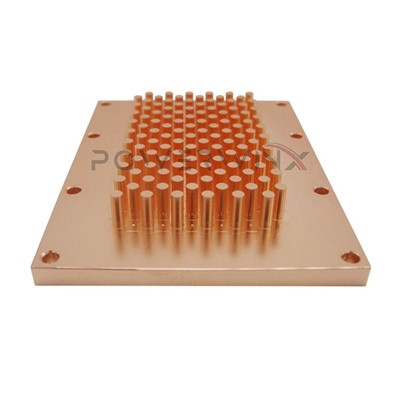
We've designed custom - shaped heat sinks to fit unique applications. Sometimes, we even use complex geometries like pin - fin or micro - channel designs to increase the surface area and improve heat transfer. These advanced designs can be particularly effective in high - performance applications where traditional fin designs won't cut it.
Comparison with Other Types of Heat Sinks
When it comes to heat sinks, there are several other types on the market. For example, Die Cast Aluminum Heat Sink offers high precision in complex shapes but may have limitations in terms of fin density and thermal performance. Stamped fin heat sinks, on the other hand, can be more cost - effective and offer a good balance between performance and manufacturability.
Another type is the Stainless Steel Folded Fin Heat Sink. Stainless steel is known for its corrosion resistance, but it has relatively low thermal conductivity compared to aluminum or copper. Stamped fin heat sinks can be made from a variety of materials, allowing us to choose the most suitable one for the application.
Conclusion
In conclusion, the design of a stamped fin heat sink has a huge impact on its performance. From fin thickness and height to base material and surface finish, every design element needs to be carefully considered to optimize heat dissipation. As a stamped fin heat sink supplier, we're committed to working with our customers to understand their specific needs and design the perfect heat sink for their applications.
If you're in the market for a high - performance stamped fin heat sink, or if you have a unique heat transfer challenge, don't hesitate to reach out. We're here to help you find the best solution for your project. Whether it's a standard design or a custom - made heat sink, we've got the expertise and experience to deliver.
References
- Incropera, F. P., & DeWitt, D. P. (2002). Fundamentals of Heat and Mass Transfer. John Wiley & Sons.
- Kays, W. M., & Crawford, M. E. (1993). Convective Heat and Mass Transfer. McGraw - Hill.
- Bergman, T. L., Lavine, A. S., Incropera, F. P., & Dewitt, D. P. (2011). Fundamentals of Heat and Mass Transfer. John Wiley & Sons.