Hey there! As a supplier of pin fin heat sinks, I often get asked about the differences between pin fin heat sinks and plate fin heat sinks. So, I thought I'd break it down for you in this blog post.
What Are They?
Let's start with the basics. A plate fin heat sink is, well, just like it sounds. It's made up of flat plates that are stacked parallel to each other. These plates increase the surface area of the heat sink, which helps in dissipating heat. Think of it as a series of thin, flat sheets standing side by side.
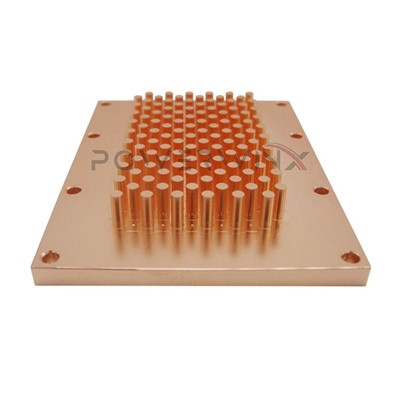
On the other hand, a pin fin heat sink consists of multiple cylindrical pins or rods that stick out from a base. These pins are arranged in a pattern, and they also serve to increase the surface area for heat transfer. It's like a bunch of tiny straws sticking up from a flat surface.
Heat Dissipation Performance
One of the most important factors when it comes to heat sinks is how well they can dissipate heat. Plate fin heat sinks are great for applications where the airflow is parallel to the fins. The flat plates create a smooth path for the air to flow over, which allows for efficient heat transfer. They work really well in situations where the heat source is large and flat, like in some power electronics.
Pin fin heat sinks, however, are more versatile when it comes to airflow. Since the pins are arranged in a three - dimensional pattern, they can handle airflow from different directions. This makes them a better choice for applications where the airflow is not well - defined or is turbulent. For example, in some computer cases where the fans might blow air in various directions, a pin fin heat sink can do a better job of dissipating heat.


In terms of heat transfer coefficient, pin fin heat sinks can sometimes have an edge. The pins create more turbulence in the air flowing around them, which can enhance the heat transfer rate. But this also depends on the size and spacing of the pins. If the pins are too close together, the airflow can be restricted, and the heat transfer efficiency might decrease.
Manufacturing and Cost
When it comes to manufacturing, plate fin heat sinks are generally easier and cheaper to produce. The process of making flat plates and stacking them is relatively straightforward. You can use techniques like extrusion, where the aluminum or other metal is forced through a die to create the fins. This method is cost - effective for large - scale production.
Pin fin heat sinks, on the other hand, are a bit more complex to manufacture. The pins need to be attached to the base in a precise way. There are different methods for making pin fin heat sinks, such as machining the pins directly from the base material or soldering pre - made pins onto the base. These processes can be more time - consuming and expensive, especially for high - precision pin fin heat sinks.
However, if you're looking for a high - performance heat sink for a critical application, the extra cost of a pin fin heat sink might be worth it. The improved heat dissipation capabilities can lead to better overall performance and reliability of the device.
Size and Space Requirements
Plate fin heat sinks are usually more compact in one direction. Since the fins are flat and parallel, they take up less space in the direction perpendicular to the fins. This makes them a good choice for applications where space is limited in one dimension. For example, in some thin - profile electronic devices, a plate fin heat sink can be a great option.
Pin fin heat sinks, on the other hand, can be more bulky. The three - dimensional arrangement of the pins means that they take up more space overall. But they can also be designed to fit into irregular spaces. You can adjust the length and spacing of the pins to optimize the heat sink for a specific application.
Applications
Plate fin heat sinks are commonly used in applications such as power supplies, LED lighting, and some types of industrial electronics. In power supplies, the large, flat heat sources can be easily cooled by the parallel fins of a plate fin heat sink. LED lighting also benefits from the efficient heat transfer of plate fin heat sinks, as it helps to keep the LEDs cool and extend their lifespan.
Pin fin heat sinks are often used in computer processors, high - power lasers, and some aerospace applications. In computer processors, the turbulent airflow in the computer case is well - handled by the pin fin heat sink. High - power lasers generate a lot of heat, and the three - dimensional heat dissipation capabilities of pin fin heat sinks are crucial for keeping the lasers operating at optimal temperatures.
Our Pin Fin Heat Sink Offerings
As a pin fin heat sink supplier, we offer a wide range of pin fin heat sinks to meet different needs. Our heat sinks are made from high - quality materials, such as aluminum, which has excellent thermal conductivity. We use advanced manufacturing techniques to ensure that the pins are precisely attached to the base, providing optimal heat transfer performance.
We also offer customization options. If you have a specific size, shape, or performance requirement, we can work with you to design and manufacture a pin fin heat sink that meets your exact needs. Whether you need a small heat sink for a consumer electronics device or a large, high - performance heat sink for an industrial application, we've got you covered.
Related Heat Sink Products
If you're interested in other types of heat sinks, we also have some great options. Check out our Aluminum Soldered Heat Sink, which offers excellent heat dissipation and is suitable for a variety of applications. Our Skived Fin Heat Sink is another high - performance option, known for its thin and efficient fins. And if you need a heat sink with enhanced heat transfer capabilities, our Heat Pipe Heat Sink might be the right choice for you.
Contact Us for Procurement
If you're in the market for a pin fin heat sink or any of our other heat sink products, we'd love to hear from you. Whether you have questions about our products, need a quote, or want to discuss a custom design, don't hesitate to reach out. We're here to help you find the best thermal solution for your application.
References
- Incropera, F. P., & DeWitt, D. P. (2002). Fundamentals of Heat and Mass Transfer. John Wiley & Sons.
- Kraus, A. D., Azar, J. R., & Welty, J. R. (2001). Extended Surface Heat Transfer. Wiley - Interscience.