Yo, what's up everyone! I'm a supplier of Cold Forged Heat Sinks, and today I wanna talk about something super important in our field: the expansion coefficient of cold forged heat sink materials.
First off, let's get a basic understanding of what the expansion coefficient is. In simple terms, it's a measure of how much a material expands or contracts when its temperature changes. For heat sinks, this is a big deal. Heat sinks are used to dissipate heat from electronic components. As the electronic devices work, they generate heat, which causes the temperature of the heat sink to rise. If the heat sink material has a high expansion coefficient, it'll expand a lot when heated. And when it cools down, it'll contract significantly. This constant expansion and contraction can lead to all sorts of problems, like loosening of connections, cracking, or even failure of the heat sink.
Now, let's look at some common materials used in cold forged heat sinks and their expansion coefficients.
Aluminum
Aluminum is one of the most widely used materials for heat sinks. It's lightweight, has good thermal conductivity, and is relatively inexpensive. The linear expansion coefficient of aluminum is around 23.1 x 10⁻⁶ /°C. This means that for every degree Celsius increase in temperature, a piece of aluminum will expand by about 23.1 millionths of its original length.


The relatively high expansion coefficient of aluminum can be both an advantage and a disadvantage. On the plus side, it allows the heat sink to quickly adapt to temperature changes, which is great for dissipating heat. But on the downside, if the heat sink is attached to a material with a significantly different expansion coefficient, it can cause stress at the interface. For example, if an aluminum heat sink is attached to a ceramic component with a much lower expansion coefficient, the repeated expansion and contraction of the aluminum can lead to the detachment of the heat sink over time.
If you're interested in aluminum-based heat sinks, check out our Aluminum Zipper Fin Heat Sinks. They're made with high-quality aluminum and are designed to provide excellent heat dissipation.
Stainless Steel
Stainless steel is another material used in heat sink applications, especially when corrosion resistance is a priority. The linear expansion coefficient of stainless steel varies depending on the specific grade, but it's generally in the range of 10 - 17 x 10⁻⁶ /°C. This is lower than that of aluminum, which means stainless steel heat sinks will expand and contract less with temperature changes.
The lower expansion coefficient of stainless steel makes it a good choice for applications where dimensional stability is crucial. However, stainless steel has lower thermal conductivity compared to aluminum, so it may not be as effective at dissipating heat. But in some cases, where the heat load is relatively low and corrosion resistance is more important, stainless steel heat sinks are a great option. You can check out our Stainless Steel Folded Fin Heat Sink for more details.
Copper
Copper is known for its excellent thermal conductivity, which is even better than aluminum. The linear expansion coefficient of copper is about 16.5 x 10⁻⁶ /°C. This is lower than aluminum but higher than some grades of stainless steel.
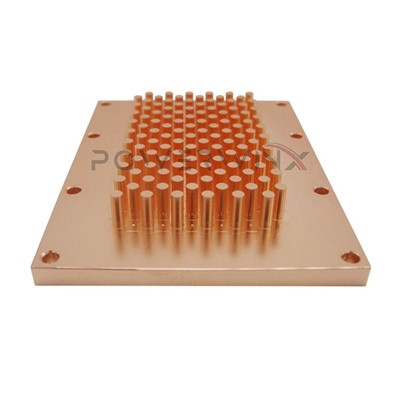
Copper heat sinks are very effective at transferring heat, but they're also heavier and more expensive than aluminum. The expansion coefficient of copper means that it can handle temperature changes well, but like aluminum, it needs to be carefully matched with other materials in the system to avoid stress issues.
Impact of Expansion Coefficient on Design
When designing a cold forged heat sink, the expansion coefficient of the material plays a crucial role. Engineers need to consider how the heat sink will interact with other components in the system. They may need to use special mounting techniques or materials to compensate for the differences in expansion coefficients.
For example, if a heat sink is attached to a printed circuit board (PCB), the expansion coefficient of the heat sink material needs to be close to that of the PCB to prevent the PCB from warping or cracking. In some cases, thermal interface materials (TIMs) are used between the heat sink and the component to help absorb the stress caused by expansion and contraction.
Our Product Range
At our company, we offer a wide range of cold forged heat sinks made from different materials. Our Zipper Fin Heat Sinks are available in both aluminum and stainless steel. These heat sinks are designed with a unique zipper fin structure that provides increased surface area for better heat dissipation.
Whether you need a heat sink for a high-power electronic device or a low-heat application, we have the right solution for you. Our team of experts can help you choose the best material and design based on your specific requirements.
Why Consider Expansion Coefficient in Procurement
If you're in the market for cold forged heat sinks, considering the expansion coefficient of the materials is essential. A heat sink with the wrong expansion coefficient can lead to premature failure of your electronic devices, which can be costly in terms of repairs and downtime.
By choosing a heat sink with an appropriate expansion coefficient, you can ensure the long-term reliability and performance of your products. And that's where we come in. We can provide you with detailed information about the expansion coefficients of our heat sink materials and help you make an informed decision.
Let's Talk!
If you're interested in our cold forged heat sinks or have any questions about the expansion coefficient of heat sink materials, don't hesitate to reach out. We're here to help you find the perfect solution for your thermal management needs. Whether you're a small electronics manufacturer or a large corporation, we can work with you to meet your requirements.
So, let's start a conversation and see how we can work together to keep your devices cool and running smoothly!
References
- "Thermal Properties of Metals, Conductivity, Thermal Expansion, Specific Heat", Engineering ToolBox
- "Materials Science and Engineering: An Introduction", William D. Callister Jr. and David G. Rethwisch