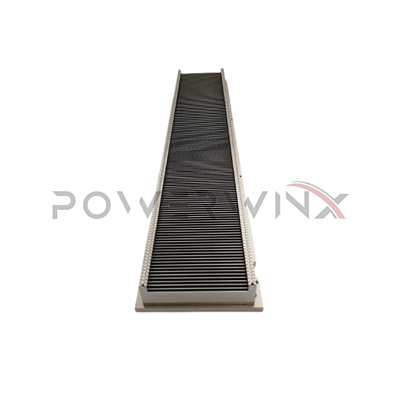
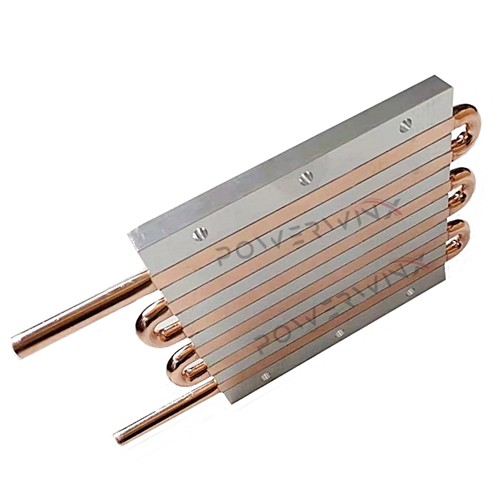
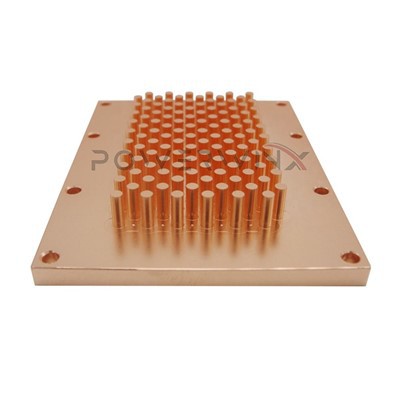
In the realm of thermal management, bonded fin heat sinks have emerged as a crucial solution for dissipating heat efficiently from various electronic components. As a leading supplier of bonded fin heat sinks, I've witnessed firsthand the importance of understanding the factors that influence their performance. One such factor that plays a significant role is the Prandtl number. In this blog post, I'll delve into how the Prandtl number affects the performance of a bonded fin heat sink and why it matters for your thermal management needs.
Understanding the Prandtl Number
Before we explore its impact on bonded fin heat sinks, let's first understand what the Prandtl number is. The Prandtl number (Pr) is a dimensionless number that represents the ratio of momentum diffusivity (kinematic viscosity) to thermal diffusivity in a fluid. Mathematically, it is defined as:
[ Pr = \frac{\nu}{\alpha} ]
where (\nu) is the kinematic viscosity of the fluid and (\alpha) is the thermal diffusivity. The Prandtl number provides insights into the relative importance of momentum and heat transfer in a fluid flow. Different fluids have different Prandtl numbers, which can range from less than 0.01 for liquid metals to over 1000 for some oils.
Heat Transfer Mechanisms in Bonded Fin Heat Sinks
Bonded fin heat sinks are designed to enhance heat transfer from a hot surface (such as an electronic component) to a surrounding fluid (usually air). The heat transfer process involves two main mechanisms: conduction and convection.


- Conduction: Heat is transferred from the base of the heat sink to the fins through conduction. The fins increase the surface area available for heat transfer, allowing more heat to be conducted away from the base.
- Convection: Once the heat reaches the fins, it is transferred to the surrounding fluid through convection. The fluid flow over the fins carries the heat away, cooling the heat sink and the electronic component.
The efficiency of these heat transfer mechanisms depends on various factors, including the properties of the fluid, the geometry of the heat sink, and the flow conditions. The Prandtl number plays a crucial role in determining the effectiveness of convection heat transfer.
Impact of Prandtl Number on Convection Heat Transfer
The Prandtl number affects the boundary layer development and the heat transfer coefficient in a fluid flow over a surface. The boundary layer is a thin layer of fluid adjacent to the surface where the velocity and temperature gradients are significant.
- Low Prandtl Number Fluids: Fluids with low Prandtl numbers (e.g., liquid metals) have a relatively large thermal diffusivity compared to their kinematic viscosity. This means that heat can diffuse through the fluid more quickly than momentum. As a result, the thermal boundary layer is thicker than the velocity boundary layer. In the context of a bonded fin heat sink, low Prandtl number fluids can provide efficient heat transfer because heat can be rapidly transferred from the fins to the fluid.
- High Prandtl Number Fluids: Fluids with high Prandtl numbers (e.g., oils) have a relatively small thermal diffusivity compared to their kinematic viscosity. This leads to a thinner thermal boundary layer compared to the velocity boundary layer. In a bonded fin heat sink, high Prandtl number fluids may result in lower heat transfer coefficients because the heat transfer is limited by the slow diffusion of heat through the fluid.
The heat transfer coefficient ((h)) is a measure of the convective heat transfer rate between the surface and the fluid. It is influenced by the Prandtl number, among other factors. In general, the heat transfer coefficient increases with decreasing Prandtl number for laminar flows. However, in turbulent flows, the relationship between the Prandtl number and the heat transfer coefficient is more complex.
Implications for Bonded Fin Heat Sink Design
The Prandtl number of the working fluid has important implications for the design of bonded fin heat sinks. Here are some key considerations:
- Fin Geometry: The fin geometry can be optimized based on the Prandtl number of the fluid. For low Prandtl number fluids, fins with a larger surface area may be more effective because heat can be quickly transferred to the fluid. In contrast, for high Prandtl number fluids, fins with a more streamlined shape may be preferred to reduce the resistance to fluid flow and enhance heat transfer.
- Fluid Selection: The choice of working fluid depends on the application requirements and the Prandtl number. For applications where high heat transfer rates are required, fluids with low Prandtl numbers may be more suitable. However, other factors such as cost, availability, and compatibility with the heat sink materials also need to be considered.
- Flow Conditions: The Prandtl number also affects the flow conditions over the fins. In laminar flows, the heat transfer is more sensitive to the Prandtl number compared to turbulent flows. Therefore, the design of the heat sink should take into account the flow regime to ensure optimal heat transfer performance.
Real-World Applications
To illustrate the practical significance of the Prandtl number in bonded fin heat sink applications, let's consider a few examples:
- Electronics Cooling: In electronic devices such as computers, servers, and LED lights, bonded fin heat sinks are commonly used to dissipate heat generated by the components. The working fluid is usually air, which has a Prandtl number of approximately 0.7. Understanding the Prandtl number can help in designing heat sinks that provide efficient cooling and prevent overheating of the electronic components. For example, Aluminum Die Cast LED Light Heat Sink and LED Heatsink are designed to optimize heat transfer in air-cooled LED lighting applications.
- Power Electronics: In power electronic devices such as inverters and converters, high-power components generate a significant amount of heat. Bonded fin heat sinks can be used to cool these components, and the choice of working fluid and fin design can be optimized based on the Prandtl number. For example, in some applications, liquid cooling with a low Prandtl number fluid may be required to achieve the desired heat transfer performance. Copper Cold Forged Heat Sink is a popular choice for power electronics cooling due to its high thermal conductivity.
Conclusion
The Prandtl number is a critical parameter that affects the performance of bonded fin heat sinks. By understanding the relationship between the Prandtl number and heat transfer mechanisms, we can optimize the design of heat sinks to achieve efficient thermal management. As a bonded fin heat sink supplier, we are committed to providing high-quality products that are tailored to the specific needs of our customers. Whether you are looking for a heat sink for electronics cooling, power electronics, or other applications, we can help you select the right solution based on the Prandtl number and other factors.
If you have any questions or need assistance with your thermal management requirements, please don't hesitate to contact us. We look forward to discussing your project and providing you with the best possible solution.
References
- Incropera, F. P., & DeWitt, D. P. (2002). Fundamentals of Heat and Mass Transfer. John Wiley & Sons.
- Kays, W. M., & Crawford, M. E. (1993). Convective Heat and Mass Transfer. McGraw-Hill.
- Holman, J. P. (2002). Heat Transfer. McGraw-Hill.