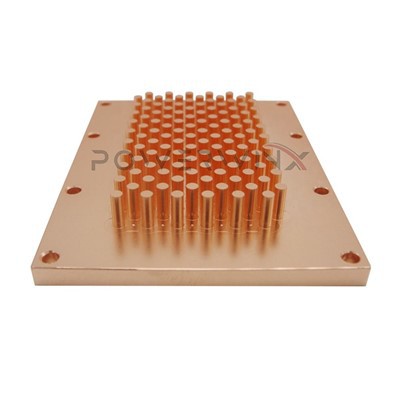
Hey there! If you're into the world of thermal management, you've probably come across the term "liquid cold plate" at some point. So, what exactly is a liquid cold plate? Well, stick around, and I'll break it down for you.
The Basics of Liquid Cold Plates
Let's start from the ground up. A liquid cold plate is a heat exchanger that uses a liquid coolant to transfer heat away from a hot component. It's like a super-efficient cooling pad, but on a more technical level. These cold plates are commonly used in high-power electronic devices, industrial equipment, and even some automotive applications.
The way it works is pretty straightforward. The hot component, like a high-performance CPU or a power amplifier, is in direct contact with the cold plate. The liquid coolant flows through channels inside the cold plate, absorbing the heat from the component. As the coolant circulates, it carries the heat away to a heat sink or a radiator, where the heat is dissipated into the surrounding environment.
Why Use Liquid Cold Plates?
You might be wondering, "Why not just use a regular heat sink?" Well, there are a few reasons. First off, liquid cold plates offer much higher heat transfer rates compared to traditional air-cooled heat sinks. This is because liquids have a much higher specific heat capacity than air, which means they can absorb more heat per unit volume.
Secondly, liquid cold plates can be more compact and efficient. In applications where space is limited, such as in aerospace or high-density data centers, a liquid cold plate can provide the same level of cooling in a much smaller package.
Another advantage is that liquid cold plates can provide more uniform cooling. Since the coolant flows through the entire cold plate, it can evenly distribute the heat, preventing hot spots from forming on the component. This is especially important for sensitive electronic devices, as hot spots can lead to reduced performance and even premature failure.


Types of Liquid Cold Plates
There are several types of liquid cold plates available on the market, each with its own unique features and advantages. As a liquid cold plate supplier, I'd like to introduce you to some of the most common types.
Hi-Contact Tube Liquid Cold Plate
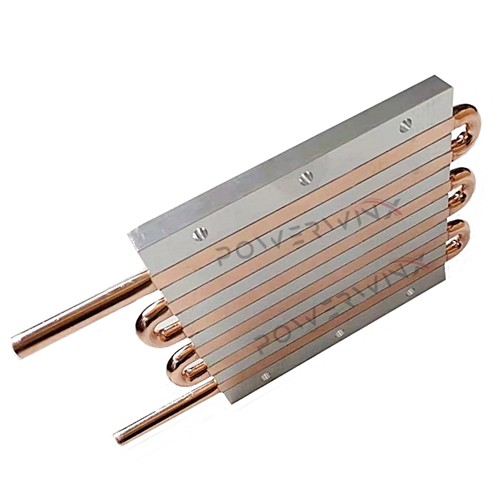
The Hi-Contact Tube Liquid Cold Plate is a popular choice for many applications. It consists of a series of tubes that are in direct contact with the hot component. The coolant flows through these tubes, absorbing the heat and carrying it away. The high contact area between the tubes and the component ensures efficient heat transfer.
Friction Welding Liquid Cold Plate
The Friction Welding Liquid Cold Plate is another type of cold plate that offers excellent heat transfer performance. It is made by friction welding two or more metal plates together to form a sealed chamber with internal channels for the coolant. This process creates a strong and reliable bond between the plates, ensuring leak-free operation.
Vacuum Brazed Liquid Cold Plate
The Vacuum Brazed Liquid Cold Plate is a high-performance cold plate that is commonly used in demanding applications. It is made by brazing a series of fins or channels onto a base plate in a vacuum environment. This process creates a strong and efficient bond between the fins and the base plate, allowing for maximum heat transfer.
Materials Used in Liquid Cold Plates
The choice of materials for a liquid cold plate depends on several factors, including the application requirements, the operating environment, and the cost. Some of the most commonly used materials include aluminum, copper, and stainless steel.
Aluminum is a popular choice due to its low cost, high thermal conductivity, and lightweight. It is also resistant to corrosion, making it suitable for a wide range of applications.
Copper has even higher thermal conductivity than aluminum, making it an excellent choice for applications where high heat transfer rates are required. However, copper is more expensive and heavier than aluminum, so it may not be suitable for all applications.
Stainless steel is a durable and corrosion-resistant material that is often used in harsh environments. It has a lower thermal conductivity than aluminum and copper, but it can still provide adequate cooling in many applications.
Design Considerations
When designing a liquid cold plate, there are several factors that need to be considered. These include the flow rate and pressure drop of the coolant, the size and shape of the channels, and the placement of the inlet and outlet ports.
The flow rate and pressure drop of the coolant are important because they affect the efficiency of the heat transfer. A higher flow rate generally results in better heat transfer, but it also increases the pressure drop, which can require a more powerful pump.
The size and shape of the channels also play a crucial role in the performance of the cold plate. The channels need to be designed to ensure that the coolant flows evenly through the entire cold plate, maximizing the heat transfer area.
The placement of the inlet and outlet ports is also important. They need to be located in a way that allows for easy connection to the coolant system and ensures that the coolant flows through the cold plate in the most efficient manner.
Applications of Liquid Cold Plates
Liquid cold plates are used in a wide range of applications, including:
- Electronics Cooling: Liquid cold plates are commonly used to cool high-power electronic devices, such as CPUs, GPUs, and power amplifiers. They can help to improve the performance and reliability of these devices by keeping them at a safe operating temperature.
- Industrial Equipment: In industrial applications, liquid cold plates are used to cool motors, generators, and other high-power equipment. They can help to reduce energy consumption and extend the lifespan of the equipment.
- Automotive: Liquid cold plates are also used in the automotive industry to cool electric vehicle batteries, power electronics, and other components. They can help to improve the efficiency and performance of electric vehicles.
- Aerospace: In the aerospace industry, liquid cold plates are used to cool avionics, radar systems, and other critical components. They need to be lightweight, compact, and reliable, making them a challenging application for liquid cold plates.
Conclusion
So, there you have it! That's a brief overview of what a liquid cold plate is, how it works, and why it's important. As a liquid cold plate supplier, I'm always happy to help customers find the right solution for their specific needs. Whether you're looking for a standard cold plate or a custom-designed solution, I can provide you with high-quality products and excellent customer service.
If you're interested in learning more about liquid cold plates or if you have a specific application that you need help with, please don't hesitate to contact me. I'd be more than happy to discuss your requirements and provide you with a quote. Let's work together to find the best thermal management solution for your project!
References
- Incropera, F. P., & DeWitt, D. P. (2002). Fundamentals of Heat and Mass Transfer. John Wiley & Sons.
- Bergman, T. L., Lavine, A. S., Incropera, F. P., & DeWitt, D. P. (2011). Introduction to Heat Transfer. John Wiley & Sons.
- Kakac, S., & Pramuanjaroenkij, A. (2005). Handbook of Single-Phase Convective Heat Transfer. John Wiley & Sons.